Initial Access Detection
Phishing payload execution, exploit kit activity, credential stuffing, and supply chain compromise indicators.

Advanced Threat Detection, Around the Clock
Cyber threats often remain undetected for weeks or even months, giving attackers time to steal data and disrupt operations. PlutoSec's Threat Detection services provide continuous monitoring, advanced analytics, and expert threat analysis to identify suspicious activity before it becomes a serious incident.
We map detections to real adversary tactics using the MITRE ATT&CK framework, not generic rules.
Every alert includes context, severity, and recommended response actions to reduce investigation time.
Threat intelligence and detection data remain protected under strict Canadian data protection standards.
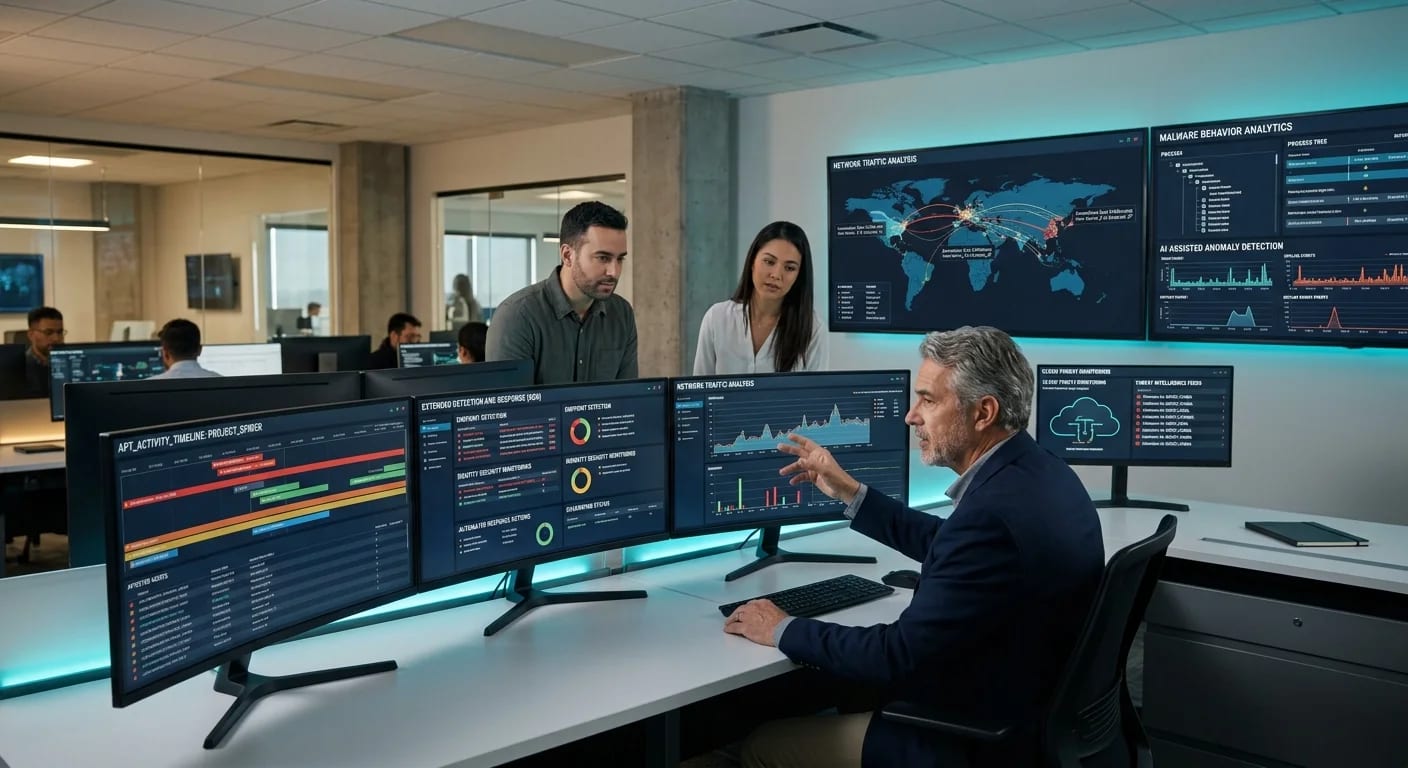
Built on the MITRE ATT&CK framework, PlutoSec's threat detection program continuously evolves to match emerging attack techniques. Our analysts refine detection rules and monitoring strategies to keep pace with today's threat landscape.
INDUSTRIES WE SERVE
From regulated industries to critical infrastructure, our assessments are scoped for your sector's specific threats and compliance requirements.
Get Started
Protect your business with expert led security assessments, penetration testing, and managed security services. Talk to our specialists today.
We identify the threat actors and techniques most relevant to your industry, size, and geographic footprint using current threat intelligence.
Our analysts build and tune detection rules, behavioral baselines, and correlation logic mapped to the MITRE ATT&CK framework.
Endpoint, network, cloud, identity, and email data sources are integrated to provide the full spectrum visibility required for multi stage attack detection.
Our team monitors detection output around the clock, investigating alerts and distinguishing genuine threats from benign anomalies.
Beyond reactive detection, our analysts conduct proactive hunting exercises targeting techniques that have not yet triggered automated rules.
Why Choose PlutoSec for Threat Detection
Alert fatigue is one of the biggest problems in enterprise security today. Organizations that generate thousands of low quality alerts quickly find that their analysts stop investigating them. PlutoSec solves this problem through layered detection engineering that eliminates noise before it reaches an analyst. Our detection program is calibrated to your specific environment and threat profile, which means the alerts your team sees represent genuine risk, not background noise. Our certified analysts, combining OSCP, CISSP, and CEH credentials, bring offensive security intuition to defensive detection, building rules that reflect how attackers actually operate rather than how vendors assume they do.
Detect suspicious behavior that traditional tools may miss.
Human led investigation and threat validation.
Identify and contain threats before they escalate.
Phishing payload execution, exploit kit activity, credential stuffing, and supply chain compromise indicators.
Pass the-hash, Kerberoasting, RDP abuse, SMB exploitation, and internal reconnaissance behavior.
Token manipulation, sudo abuse, service account misuse, and Active Directory privilege escalation techniques.
Scheduled task creation, registry modification, startup folder abuse, and backdoor implantation activity.
Large volume outbound transfers, DNS tunneling, C2 beaconing, and cloud storage abuse indicators.
Shadow copy deletion, mass file modification, backup interference, and encryption staging activity.
What You Get
Get Started
Protect your business with expert led security assessments, penetration testing, and managed security services. Talk to our specialists today.
Early threat detection helps prevent cyberattacks from turning into costly security incidents.
Gain deeper insight into suspicious activity across endpoints, networks, cloud environments, and user accounts.
Faster threat identification enables quicker investigation, containment, and remediation efforts.
Insights & Research
Hands on analysis from our engineers, current vulnerabilities, emerging attack patterns, and the security decisions shaping enterprise risk in 2026.
Cloud security is evolving fast in 2026, and Canadian businesses need to be prepared. From new threats to compliance requirements, learn how to protect your cloud
Read articleFAQ
Answers to the questions we hear most. Still unsure how it applies to your environment? Our engineers are happy to talk it through.
Get Started
Book a short consultation with PlutoSec and get a practical view of where your current security model may be exposed.