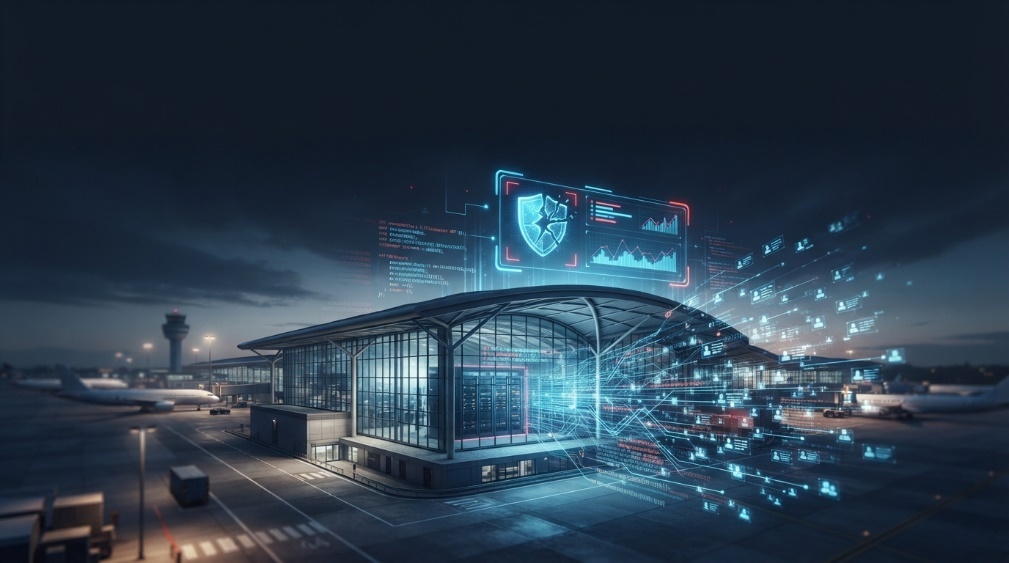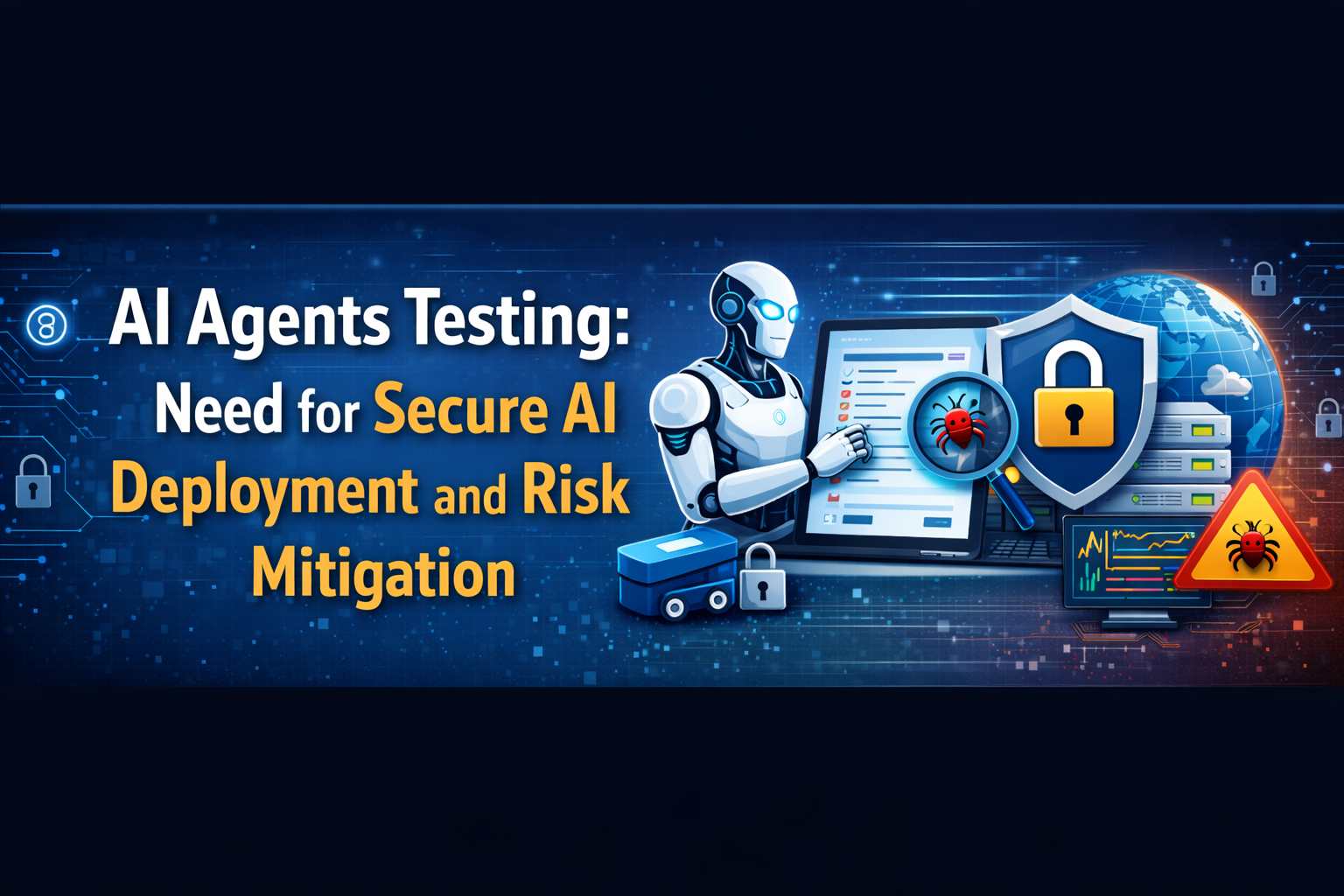
AI agents are evolving fast. They can analyze and make decisions, and take actions with minimal human intervention. They are greatly used in automation, customer support, data processing, and business decisions of many businesses today.
Such systems are frequently linked to APIs, databases, and cloud platforms. Different model languages are used in other systems. Others are not standalone; they are combined with enterprise tooling.
This is autonomy that creates opportunity. It also creates risk. The conventional cybersecurity was designed to suit static applications. AI agents are dynamic. They learn. They adapt. They give output in real time.
The attack surface is increasing due to the deployment of smarter systems in organizations. In the absence of organized AI Agents Testing, companies can leave themselves vulnerable to manipulations and misuse of critical systems.
What Is AI Agents Testing?
AI Agents Testing is an exclusive method of security that is used to test autonomous AI. It is concerned with finding vulnerabilities peculiar to AI models, decision engines, and language-based systems. This is unlike conventional application testing as it examines the behavior of AI when it is manipulated.
AI agent security testing considers
Model logic
Decision-making pathways
Data input handling
Integration points
Output reliability
It goes beyond code scanning. It looks at ways of how attackers can manipulate the model behavior, the way it can overcome safeguards or even trust limits.
AI systems need a security discipline. A normal penetration test cannot be considered sufficient.
New AI Systems Security Risks
AI models handle inputs of prompts and data streams as well as context. This is the reason why they are powerful. It also exposes them to vulnerability. There is the ability to manipulate inputs. They can poison training data. They can use vulnerabilities in model correspondence.
Some risks include
- Prompt manipulation
- Model extraction
- Data leakage
- Hack attempts on the system.
These threats are not blocked by traditional firewalls. To identify the underlying vulnerabilities of AI systems, vulnerability testing should be done in a structured way by security teams.
The requirement to safeguard AI has grown as organizations move closer to AI adoption.
AI Model Penetration Testing and LLM Security Assessment
The AI models should be checked in more detail compared to traditional models.
Penetration testing of AI models is an attack simulation on AI engines. In the case of systems driven by large language models, the evaluation of the trustworthiness of the LLM security becomes critical. Prompts can be used to cause language models to behave in a certain way. They can either disclose confidential information or accidentally take some action.
Testing examines: Organizations can potentially release intelligent systems that look safe unless they are tested against adversarial conditions and fail. How Attackers Manipulate AI Systems Prompt injection is one of the gravest risks to AI agents. Last Adversarial AI testing determines the response of the models to harmful or misleading inputs. It is used to determine flaws in arguments and teaching management. Prompt injection testing is a particular test to examine whether attackers are able to overwrite system instructions. As an example, an attacker can lure an AI agent to divulge internal information or unwanted commands. In addition to the fact that AI agents are capable of interacting with other systems, these exploits can easily become massive within a matter of time. These attacks have to be simulated by security teams before deployment. AI Threat Modeling and Red Teaming Achievement of success in security begins with risk comprehension. The AI threat modeling is a mapping of AI agent interaction with the user, systems, and data. It helps a lot in detecting the weak points besides the points of trust. It is a systematic method of bringing out the high-risk elements early. Other than modelling, AI red teaming mimics actual attackers. In controlled scenarios, security specialists will be trying to compromise the AI system. They do edge case tests, policy bypass tests, and exploitation policy tests. Red teaming reveals vulnerabilities that would not be detected by automated tools. Threat modeling coupled with red teaming forms a realistic perspective of AI risk exposure. After deployment, security should not start. It should be involved at the very beginning. Safe AI deployment testing involves testing the hardening of the AI systems prior to their actual implementation. It checks configurations, access controls, monitoring mechanisms, and fail-safe mechanisms. Structured AI risk assessment should also be performed by organizations to assess the business's impact. This includes: AI has become part of the main business procedures. Any failure may be far-reaching. The presence of a structured security program lowers the level of uncertainty and enhances resilience. With the change in the environment oftechnology, the necessity changes. AI is one of the systems that is simple tech. Organizations need to comply with these techniques. These techniques include automation, professional testing, and constant monitoring. They require those experts who are conversant with AI behaviour and cyber risk management. Plutosec enables companies by providing a framework of AI agent security testing, advanced AI model penetration testing, and deep LLM security testing. This strategy is a blend of intelligent automation and the use of human-led AI red teams to identify risks that attackers are ignoring. With the help of Plutosec, businesses are able to: Provided that your organization is implementing intelligent systems, now is the moment to make AI Agents Testing your priority in your overall approach to cybersecurity. You can contact Plutosec via email contact@plutosec.ca or you can directly contact through +1(905) 367-6038. Hire Us And Upgrade The Security of Your Organization. The agents of AI are changing the way business operations. They enhance efficiency, make decisions automatically, and open innovation. However, autonomy brings in new dangers. The usual security testing is not able to offer complete protection to the dynamic AI systems. AI systems that involve a specific set of systems are ideal for companies. This set of features covers adversarial simulation, systematic risk modeling, and deployment validation. Since AI system vulnerability testing and AI red teaming fall under proactive security, intelligent systems are dependable and secure. The security needs to keep abreast with AI as it becomes the core of business operations. The businesses that invest in AI today shall be confident tomorrow. This is a security process that is designed to test autonomous AI systems. It detects faults in AI procedures, decision-making, integrations, and model logic before they are utilized by hackers. Security testing of AI agents is based on model manipulation, immediate abuse, and risks of the AI's behavior. Traditional penetration testing is largely focused on application code, networks, and infrastructure. AI model penetration testing is an attack simulation against AI systems. It evaluates model behavior to malicious prompts, data manipulation,n and adversarial data. An LLM security checkup will guarantee that big theoretical models do not reveal delicate information, obey destructive guidelines, and yield perilous outcomes. Adversarial AI testing examines AI systems in their adversarial behavior. It verifies the possibility of attackers deceiving or cheating the model. AI threat modeling can be used to detect potential attack patterns, information exposure points, and confidence boundaries of AI systems. It aids in the prioritization of security controls. An AI risk assessment measures business impact, compliance exposure, and operational dependency. It is the provider of secure AI deployment prior to the live systems.
This is aimed at making sure that the models will act safely even under pressure.
How Attackers Manipulate AI Systems
The Need for AI Security Specialists
Conclusion
FAQs
What is AI Agents Testing?
What is the difference between AI agent security testing and penetration testing?
What is penetration testing for AI models?
What doesLLM security assessment mean?
What is meant by adversarial AI testing?
What is AI threat modeling?
Importance of risk assessment of AI crucial before deployment?

Written by
Admin User