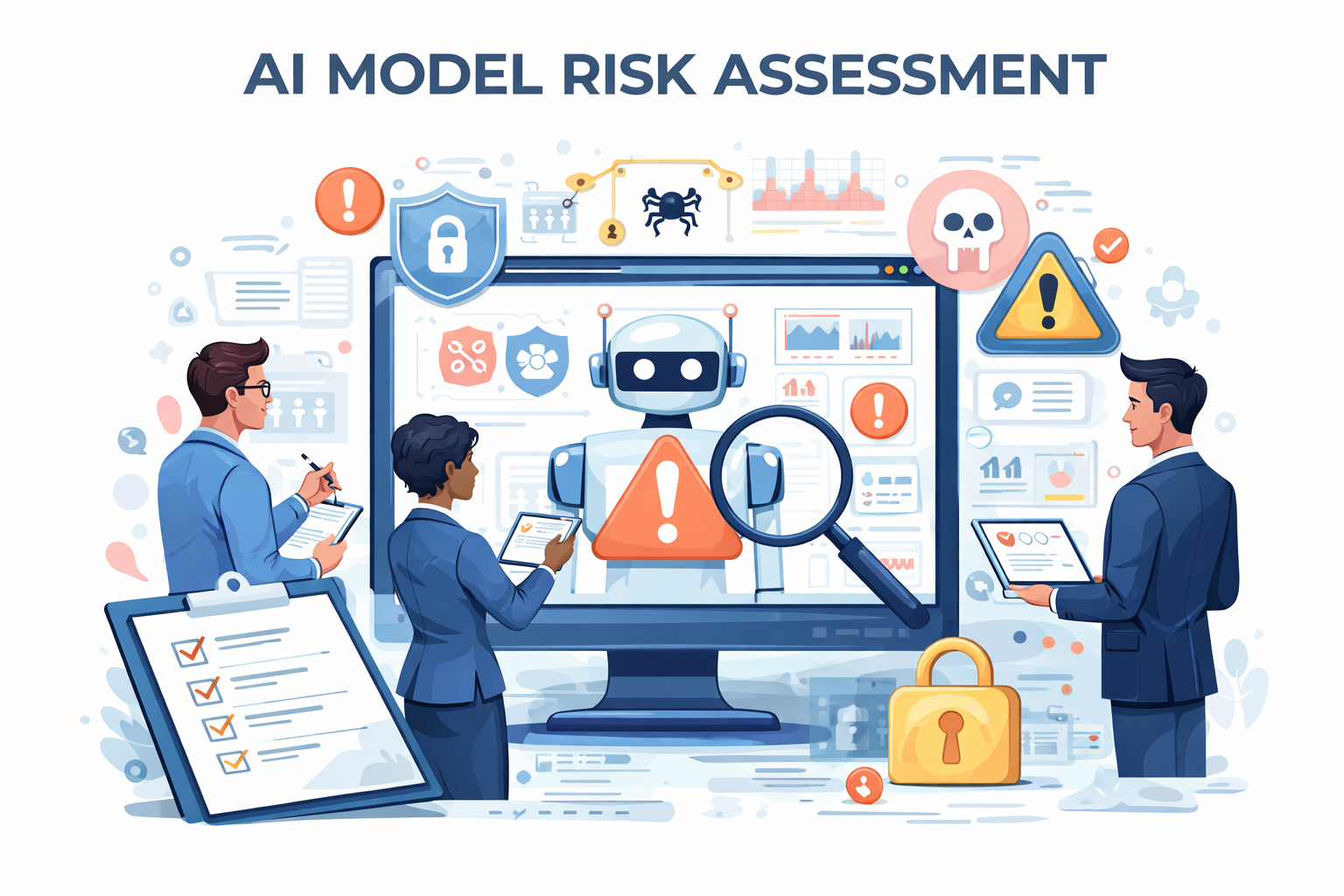
Now, artificial intelligence has become an important component of contemporary business systems. AI can be adopted by companies to make them automated, detect fraud, and participate in communication with their customers. These technologies make work more efficient, but they also provide new cybersecurity threats that are not fully understood by many organizations.
That is why AI risk assessment should be done systematically by businesses before the implementation of AI systems in the production setting. Having not been properly evaluated, AI models can reveal sensitive data, make wrong decisions, or fall prey to cyber attacks.
AI threat modeling and regular AI security audit processes in the form of periodicals have found their way into security teams in a bid to comprehend how attackers can use AI systems. The practices are beneficial in assisting organizations to deploy AI without jeopardizing operational trust.
The reason why AI Systems pose New Security threats
The conventional software operates with established reasoning. AI systems do not act in the same way. They are trained on huge collections of data and produce results according to patterns.
Due to this action, there are special security challenges that are created through AI models. Attackers can interfere with training data, abuse related APIs associated with AI models, or manipulate the reaction to inputs of the model.
The absence of AI risk assessment can lead to the existence of these weaknesses within the system. Organizations might suffer data leakage, derailment of operations, or even losses when attackers use them.
Carrying out AI threat modeling enables enterprises to realize these threats at the company in the early stages of deployment.
Threat Modeling of AI: The role of AI threat modeling
AI threat modeling represents an organized process of finding potential attack vectors against AI systems. Security teams reverse engineer attacker interaction with the model, the model data pipeline, and infrastructure.
This process focuses on system architecture, source of data, model outputs and integrations with the exterior. Through research on such elements, specialists are in a position to be able to detect vulnerabilities before they are exploited by attackers.
An appropriate AI threat modeling process usually considers:
- Implementation training on data integrity
- AI systems access control.
- API and integration security.
- Disclosure of confidential information.
- Reinforcement of AI model outputs.
Such insights enable organizations to enhance security controls and minimise threats that may occur. Reasons Why Businesses Should Audit Using AI Implementing AI without testing its security is a significant risk. AI systems have an impact on business decisions, customer services, and automated workflows. A professional AI security audit assists companies in measuring the security state of their AI systems. Model architecture, infrastructure, and access controls are reviewed with security experts to identify the latent vulnerabilities. In an AI security audit, teams also expect AI systems to respond to malicious/crafted inputs or patterns of abnormal data. Companies that undertake regular audits are in a position to detect vulnerabilities before they create security breaches. Poor AI Risk Management- Impact on Business. Organizations pay much attention to the performance of AI and its accuracy. Not addressing security risks, however, can be costly to a business. In case AI systems break down or are hacked, the shock can extend to various business processes. Some risks normally affect businesses, such as: Making use of an extensive AI risk evaluation will assist organizations to identify the mentioned issues early and take preventive measures. Artificial Intelligence Adherence and Regulatory Requirements The rise of the technologies of artificial intelligence is already regulated by governments. Companies also need to see to it that the AI systems are developed in a responsible manner in terms of business development, as well as security. The organizations in the United States are bound to adhere to the emerging AI compliance USA nomenclature, which is concentrated on transparency, security testing, and responsible AI usage. Regulatory requirements in combination with AI threat modeling and AI security audit processes are often combined by security teams. This makes AI systems work safely and at the same time, comply as it is expected. Companies that are eager to implement risk management measures are better equipped for the new regulations in the future. The Significance of an AI Governance Framework AI technologies need proper policies and management practices. The manner in which AI systems are created, tracked, and safeguarded should be defined by organizations. This is why a formal AI governance framework will be fundamental. A good governance model means that AI projects adhere to security principles, ethical regulations, and working standards. It also assigns roles of the development, security, and compliance teams. When organizations have a robust AI governance structure, they have superior control over the use of AI and lower the risk in the long term Applying the NIST AI Risk Framework The framework of NIST AI risk gives practical advice to organizations concerning the management of AI security risks. It assists enterprises in detecting threats, assessing possible risks, and providing the necessary protection. This framework helps security teams to assess risks throughout the AI lifecycle, such as development, deployment, and monitoring. Organizations will be able to develop more reliable and secure AI systems by matching their approaches to AI risk assessment with the NIST AI risk framework. The use of standardised frameworks also exhibits high levels of cybersecurity maturity to the stakeholders and regulators. Regulation of Artificial Intelligence Risk in North America The use of artificial intelligence is ever-increasing in North America. The United States and Canada are the locations where companies use AI technologies to enhance business operations. Nevertheless, these organizations have to take into consideration the needs of the regional security and compliance expectations. To illustrate, the companies that conduct their activity in Canada will need to track the developing AI risk regulations in Canada without violating the global cybersecurity norms. An AI risk assessment and AI threat modeling are structured, which can assist businesses in handling these regional issues with ease. The organizations that constantly review their AI systems will be more agile to the future changes in regulatory initiatives. Enhance AI Security Predeployment Artificial intelligence is extremely beneficial to big business. Nonetheless, the implementation of AI systems without due security testing may put organizations at grave risk. Companies implementing AI without proper reevaluation of AI can lose data, get affected by altered results, or even lose business. Proactive security approach encompassing AI threat modeling, routine AI security audit, and good governance practices are effective measures that organizations use to safeguard their AI systems. The cybersecurity team at Ploutosec assists organizations in exposing the vulnerabilities of AI systems to attackers prior to their launching attacks. You have an open exposure window, in case your organization has been implementing AI without testing it. Visit Ploutosec today at +1 (905) 367-6038 or contact@ploutosec.us to get to know how our AI-based security experts can protect the strength of your AI infrastructure. Artificial intelligence systems need to be smart and active in terms of their protection by modern enterprises. Protect your AI technology before threats crop up. FAQs What is AI risk assessment? The concept of artificial intelligence risk assessment is an approach to detecting vulnerabilities and security risks that can attack artificial intelligence systems. What is the significance of AI threat modeling? Before deployment, AI threat modeling assists organizations in determining the possible attack vectors and vulnerabilities in security in AI systems. What is in an AI security audit? An AI security audit assesses AI models, training data, infrastructure, and integrations to identify vulnerabilities in security. What is the NIST risk framework of AI? The NIST AI risk framework offers a way of identifying and managing the risks related to artificial intelligence technology. So what is the significance of AI governance? An AI governance model enforces the compliance of AI systems to security policies, ethical standards, and regulations.

Written by
Admin User