The Hidden Azure Security Gaps Canadian Businesses Overlook. Adoption of the cloud across Canada has increased at a rapid pace, with most organizations using Microsoft Azure to power their main workloads, keep sensitive data, and control their businesses. Although such a change has made it easier to scale and be efficient, it has also added new security risks, which are frequently disregarded.
The majority of breaches in cloud settings are not a result of sophisticated hacking strategies. They occur due to mere misconfigurations, ineffective access controls, and visibility. That is why the Azure Security for Canadian Businesses is not an option anymore. It is an essential necessity for the operations of keeping a secure and compliant business.
Since cyber threats are increasingly organized and targeted, organizations have to enhance their cloud computing security strategy in Canada and address their security gaps as quickly as possible before they are exploited.
The Hidden Azure Security Gaps Canadian Businesses Overlook
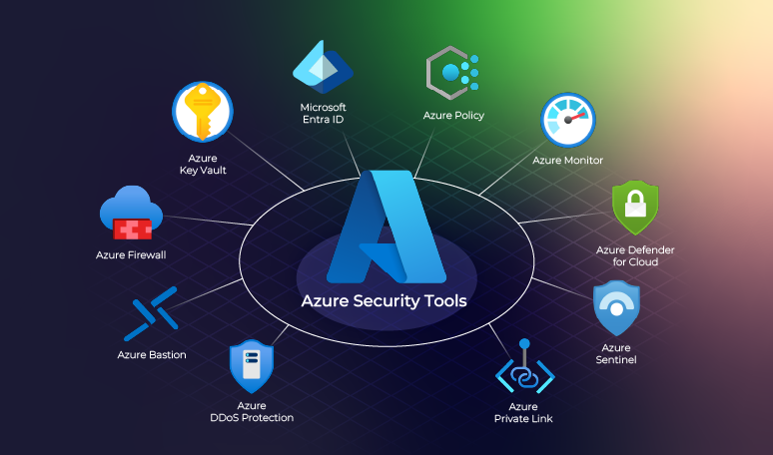
Several organizations believe that an automatic transition to Azure makes their systems secure. As a matter of fact, the concept of cloud security is based on a shared responsibility model, where businesses devise their own environment and provide security. Many of these common gaps are excessive user permissions, weak identity controls, unmonitored activity, and a lack of a well-defined security policy. These problems form access points to attackers, even in otherwise secure settings. One of the most serious issues is the weak identity management of Azure. Attackers can also easily navigate in the system once they access it at all because their movements are not well-defined by access controls. Equally, there is no formidable Blueprint of security policy in Canada that ensures workload protection is uniform. All these loopholes usually go unnoticed until the actual attack is made. Attacker Opportunities of Azure Environments Attacks based on Azure are always infrequent. Their trail of absence of controls and misconfigurations is clear. The usual situation starts with tampered credentials. The attacker is able to get into it by means of phishing or by using breached login information. After entry, they exploit security weaknesses of the Azure AD to upgrade privileges. Unless the identity controls are stringent, the attacker is able to get administrative access. Then, they go laterally through systems, receiving and stealing sensitive data from other services. In other instances, intruders may install a backdoor so that they can have long-term access. Even well-designed systems may be broken even when their environments are not well secured and validated continuously. That is the reason why basic configurations are not enough to secure the workloads of Secure Azure. Fixing Identity and Access Risks in Azure Cloud security is based on identity. When identity systems are poor, the whole environment is at stake. Firm Azure identity control begins with restricting access according to the roles and duties. The amount of permissions granted to users should correspond to the required ones only. To mitigate the chance of account intrusion, multi-factor authentication must be conducted on all privileged accounts. It is also necessary to monitor. The organizations need to monitor the use of logs, identify suspicious activity, and address the possible threats promptly. Enhancement of Azure AD security can be used to avoid escalating privileges and gaining advanced access for attackers. The overall attack surface can be considerably decreased by businesses that are able to secure identity systems. Enhancing Network Security and Firewall Settings Another important area, which most businesses have failed miserably at, is network-level protection. The systems are usually exposed to avoidable risks through poorly set endpoints and open ports. Adequate setup on Azure firewall configuration can be used to regulate inbound and outbound traffic to make sure that only validated connections are granted. Isolation of critical systems should also be introduced to segregate them in the environment so that attackers do not have freedom in any facet of the network. Microsoft has several built-in tools under Microsoft Azure security but the tools require proper configuration to be used. They bring minimal protection without adequate installation. Properly arranged network defense will minimize exposure and compress the effect of possible intrusions. The better Visibility with Azure Monitoring Lack of visibility is one of the largest threats in cloud security. There are plenty of organizations that lack understanding of what is going on in their Azure environments. Adherence to best practices of strong Azure monitoring enables the business to monitor the activity within the system, identify anomalies, and react in real time against the threat. Before suspicious activities can develop, logging, alerting, and behavior analysis are important to detect. Attackers will be able to remain unnoticed for long without proper monitoring. The visibility is not only a security attribute, but also a control requirement in cloud environments. Continuous Testing and Vulnerability Assessment The security process is not singular. Because of the evolution of the systems, there are new vulnerabilities that are introduced, and thus, constant testing is critical. A good Azure vulnerability test will detect vulnerabilities in configurations and access controls, and also in the behavior of the system. It is also useful in simulating real-life attack situations to learn how the attackers can use the environment. Unless continuous reviews are conducted, critical issues tend to be missed in organizations that depend on periodic checks. Constant testing is a way to make certain that security is not rendered irrelevant as the system scales and evolves. Canadian Businesses Have Compliance Problems The data protection and regulatory requirements are high among Canadian organizations. This is why Azure compliance Canada is a significant element of the cloud plan. Compliance is, however, misconstrued. Compliance with regulations does not necessarily imply system security. Various conforming systems continue to have loopholes in the form of security holes that can be used by attackers. Adherence to structured frameworks of the Azure security policy in Canada can assist in aligning the security practices with the compliance requirements and maintaining the protection. This makes the businesses not only resilient to threats but also compliant. Developing a 2026 Secure Azure Strategy The solutions to the security gaps in Azure have to be organized and proactive. Companies should no longer use simple setups but a holistic approach to security. This involves enhancing identity controls, enhanced monitoring, network security, and carrying out continuous testing. All these areas have to coordinate in order to protect the Secure Azure workloads. An effective prevention, detection, and response strategy can be applied. It makes sure that at the time of deployment, systems are secure and that they are secure across time. It Is Time to Fix Security Gaps Before Attackers Find Them The majority of the Azure attacks are not successful due to the advanced capabilities of those attackers. They occur due to the long period of open security gaps. It is not sustainable to wait for an incident that might reveal these weaknesses. Companies must shift to an ongoing security verification and simulation of real-world testing. Periodic reviews and the use of static configurations are insufficient to secure the current cloud settings. At Ploutosec, we do not use basic security checks. We replicate real-world attacks, determine latent vulnerabilities, and support businesses to fortify their cloud environment using long term strategies. We work with Canadian Businesses on the basis of actual threats rather than the assumption with our approach of Azure Security. The risk is there in case your Azure environment has not been tested with real-world attack behavior. Via Contact Ploutosec at +1 (905) 367-6038, or contact@ploutosec.ca to guarantee your cloud-based infrastructure. It is not possible to wait until the breach occurs. Close the loopholes before they become open FAQs So, what is Azure Security to Canadian Businesses? It means ensuring the security of the Azure environments in terms of securing identities, data, and workloads, as well as satisfying the standards of Canadian compliance. What is the significance of Azure identity management? Azure identity management is what regulates user access and helps to stop unauthorized access to cloud infrastructures. What are typical Azure security vulnerabilities? Weak access controls, poor monitoring, improperly configured firewalls, and testing are some of the common gaps. Definition of Azure vulnerability assessment? An Azure vulnerability test determines the vulnerability in cloud environments and will prevent exploitation. What can the businesses do to guarantee that they are compliant with Azure in Canada? Through adherence to benchmarks of the Azure compliance Canada and the establishment of organized practices of the Azure security policy Canada.

Written by
Admin User